Advocating for Quality Early Learning For All

America is facing a childcare and quality early learning crisis that impacts most households with children under age 5, and which costs the national economy approximately $121 billion annually. When parents can't find or afford quality care for their young children, they often cannot work. This harms their family's financial stability and contributes to job vacancies, further straining the economy.
Meanwhile, childcare centers struggle to pay their staff a living wage, as higher wages would make the cost of care unaffordable for most families.
This is not just an economic problem, though. This crisis affects America as a people due to millions of our children not having access to quality early learning, where they can begin to learn the vital skills they need in order to thrive -- essential personal life skills education should begin at birth as a part of quality early learning.
For every child, the years from birth to 5 years are when they can begin to learn essential personal life skills. Since these years are foundational to everyone's life, it is vital that every child start to learn these skills during these years to become their best selves.
When children play and learn in the same sandbox, they do better together now and in the future. We CAN solve the childcare crisis by reducing government waste NOW, and investing in ALL American children. Ask your elected officials, "What's more important than investing in ALL of our children?"

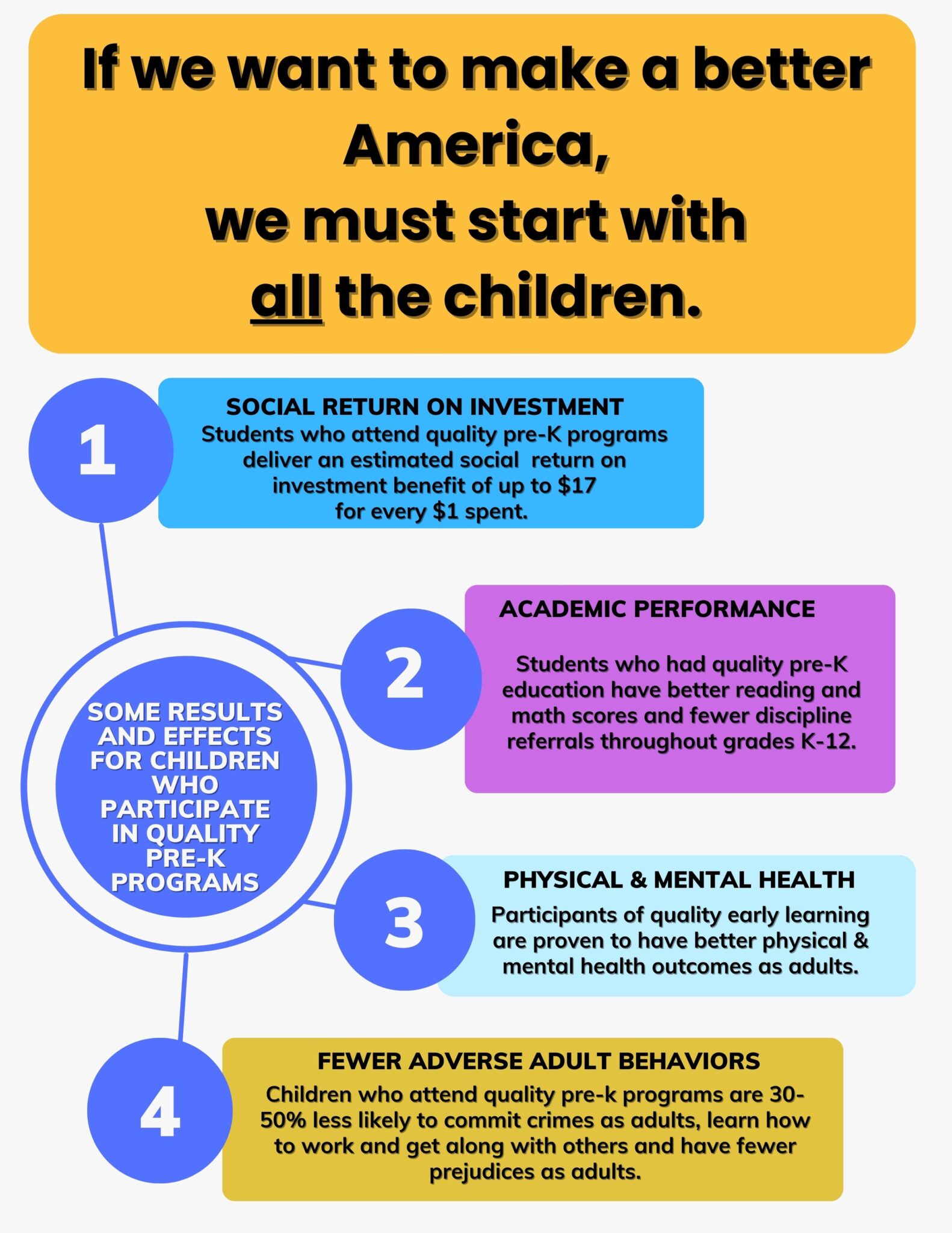
The cost per child for early learning is just slightly more than the cost for public education - we must invest in ALL children to help them avoid costly personal and interpersonal problems down the road -- problems that can cost taxpayers more money for the social programs we now have in place to address those problems.
A person's character -- if built on a weak foundation -- always needs repair. It’s time to make a change! Our kids need and deserve this!
QUESTIONS & ANSWERS ABOUT QUALITY EARLY LEARNING FOR ALL CHILDREN FROM BIRTH TO AGE 5
- Is it better for preschool children to be at home with parents, or is quality early learning a better option—and why?
Parents and caregivers are a child’s first and most important teachers. However, most parents are not equipped to teach their preschoolers all they need to truly learn, and high-quality early learning programs provide children with structured opportunities to develop social and emotional skills that are difficult to replicate in isolation.¹
In quality early learning settings, children learn to:
- Understand and name their emotions¹
- Play, share, and cooperate with other children²
- Resolve conflicts in healthy, age-appropriate ways²
- Build confidence, independence, and self-esteem¹
Children benefit most when families and quality early learning work together, supporting both emotional well-being and learning readiness. ¹ ²
- Why should we implement quality early learning for ALL children as part of our education system?
From birth to age five, children begin developing the emotional and social skills that shape how they learn, behave, and relate to others for the rest of their lives.¹ When quality early learning is part of our education system, children are more likely to:
- Develop emotional regulation and self-control¹
- Build positive relationships with peers and adults²
- Feel confident and capable in group learning environments²
- Enter kindergarten both socially and academically ready³
Research shows that long-term success is driven as much by social-emotional development—such as motivation, self-control, and cooperation—as by early academic skills.³ ⁴
- Why can’t philanthropists fund subsidies instead of advocating for public investment?
Philanthropy is important, but it cannot provide the consistent, long-term environments children need to develop healthy social and emotional skills.¹ ⁴
Research shows that children benefit most when early learning environments are:
- Stable and predictable¹
- High-quality and developmentally appropriate²
- Available consistently across early childhood years⁴
Public investment allows early learning to operate as essential infrastructure—ensuring that all children, not just a limited few, have access to environments that support emotional development, relationships, and long-term well-being.¹ ⁴
- What are the biggest problems in America’s early learning system—and how can we fix them?
Current challenges include:
- High-quality preschool is unaffordable for many working families²
- Access often depends on income, location, or eligibility rules²
- Children often lack opportunities to develop social skills in inclusive settings¹
- Early learning environments are inconsistent in supporting emotional development¹ ⁴
How we can fix them:
- Treat early learning as a public good, not a private luxury ⁵
- Ensure programs intentionally support self-understanding, empathy, cooperation, and emotional regulation¹ ²
- Invest in well-trained educators who support social and emotional growth²
- Create inclusive early learning environments where children from different backgrounds learn and play together¹
Research is clear that when children grow and learn together early in life, they are more likely to develop empathy, reduce bias, and build stronger relationships—benefits that last well beyond the classroom.¹ ²
References
- National Scientific Council on the Developing Child.
The Foundations of Lifelong Health Are Built in Early Childhood. Harvard University. - Learning Policy Institute.
Untangling the Evidence on Preschool Effectiveness. - HighScope Educational Research Foundation.
The HighScope Perry Preschool Study Through Age 40. - Campbell, F. A., et al. (2012).
Adult Outcomes as a Function of an Early Childhood Educational Program: The Abecedarian Project Follow-Up. Developmental Psychology. - Heckman, J. J. (2006).
Skill Formation and the Economics of Investing in Disadvantaged Children. Science.
How to use santorofoundation.org
This website is a free resource of material to help improve essential personal life skills. The materials on this website range from individual “sayings” to a full personal life skills curriculum program called Alive2Thrive. To help you become your best self, please review all this site has to offer. It is important you pass this site along to others so they can be the best they can be, and by doing so, we will build a better society.